22 February 2009

Ray of Light Beef Tacos

I have decided that Tyler Florence is the only ray of light left on the Food Network. When I first started receiving cable TV two years ago, I spent hours on end watching all of Food Network's stars and their various shows, and felt impressed by the overall quality; I learned techniques, flavor combinations, and menu ideas. These days though, I am more inclined to agree with the gourmet food establishment's verdict that Food Network isn't an interesting foodie venue. Now that I have Bravo on my lineup of channels, I too will move on to the show, Top Chef. Food Network has stumbled by bringing on new faces with no aura of expertise (Ask Aida, and all those Next Food Network Star winners), repeating too much content from their established stars (Giada's gotten downright boring), and dumbing down their content rather than moving on to new heights for their more seasoned viewers.

So why do I still like Tyler Florence's show? He cooks recipes I'd like to eat, and always arranges the show into a cohesive menu that usually involves a challenging element - whether it's an unusual ingredient, or a new technique. I enjoy watching to see how he layers flavors in particular. This weekend Marcus and I cooked his ultimate beef tacos, which turned out sublimely. We made a double batch to last all weekend. Sear a salt and pepper-seasoned shoulder of beef in garlic infused oil, caramelize with Spanish onion slices, then cook down for almost 2 hours in a mixture of canned tomato and water (just enough to cover the beef) with bay leaves, red chili flakes, paprika, cumin, coriander - whatever looks good in your spice rack, really. This served alongside homemade salsa and guacamole was perfect. We didn't do the elote asado (grilled corn with cheese, lime, and chili powder) because it didn't look fresh at the market. I'll be good and wait until summer. With all this how could we choose anything else but a Negra Modelo cerveza to drink.

This isn't the first time TF has come through with excellent inspiration either - his brined pork chops with pan apple sauce is still a staple in my repertoire, and the perfect complement to my favorite original cocktail, the Apple Crisp.

11 February 2009

Hungry in Afghanistan with No Time to Cook?

Find out what the Expats in Kabul are eating: http://easyfood.af/

Someone's making brisk trade on Westerner's time and security concerns... $10 for an Afghan kebab? Really? The menus read like a middling airport's food court offerings, which makes sense if most of the food is imported.

Our Kabul Correspondent, a.k.a. Cinnamon Jones, keeps a stiff upper lip even when faced with these unpalatable options. She subsists on my all-too-infrequent care packages of Stumptown Coffee Roaster's Hair Bender beans that I can pick up from their Chelsea Market outpost. The true gourmand that she is, she brought out her own French Press and bean grinder among her limited luggage.

Here's why she likes it so much:

"Our Hair Bender is a complex espresso blend featuring coffee components from the three major growing regions of Latin America, East Africa, and the Pacific Rim... The aroma demonstrates floral notes of jasmine while the flavor is a combination of sweet citrus, milk chocolate and caramel."

06 February 2009

Oops...

What’s your greatest kitchen mishap? I’m not talking about the unfortunately ubiquitous slivered finger, but the more dramatic events. Last night, in the midst of creating an amazingly complicated dinner, I managed to make my railroad-style kitchen so hot that the plastic exterior of my electric kettle melted into a solid block. This is the second electric kettle I’ve ruined in as many months (the last one I submerged in water while attempting to clean – apparently that’s a no-no).

One of my favorite mistakes, however, was arriving home after an epic night bartending to find Marcus and Frank sitting calmly in the living room, watching TV. Their Zen-like quality could only be fully appreciated seeing the thick film of vegetable oil they had managed to spread over the entire 450 square feet of our apartment. Apparently they had wanted steak frites, but never really knew how to fry on the stovetop. For weeks afterwards we walked on crunchy kosher salt, soaking up the remains. Our hardwood floors never looked so good.

David Tanis' North African Comfort Food


On a day when I had no idea what I wanted to eat, much less cook for a dinner party, Tanis' cookbook, A Platter of Figs, solved everything and let me create one of my best meals to date. I tweaked his menu to fit what looked good at the grocery store.

spiced carrot salad
warm chickpeas
chicken tagine with butternut squash
harissa oil
couscous
and although he recommends walnut cigars, which did look wonderful, we enjoyed a fantastic chocolate cherry cream cake brought by Erin instead.

The Recipes, Basically (with a bit of my own spin)

For the chickpeas

1 pound dried chickpeas, picked over and soaked overnight. The next day, drain them, and put them in a pot with 3 quarts of water along with an onion chopped in quarters, 1 cinnamon stick, a few cloves, a splash of olive oil, and some salt. Bring to a boil, and then lower to a simmer until the chickpeas are tender, about 1 hour. If you usually use canned beans, you'll notice this method produces meatier, more flavorful beans. Leave it to cool. You'll use the cooking water for the tagine. When the tagine's almost done cooking, reheat the chickpeas in whatever liquid's still in the pot. Drain, reserving the liquid for lubricating the couscous (if you want). Dress the chickpeas to taste with butter, cinnamon, salt, lemon juice, and chopped parsley.
For the tagine

Peel a 2 lb+ buttnernut squash (or any other winter squash like pumpkin), remove seeds, and chop into large slices. Season them all with salt, pepper, and ground cumin (toast and roughly grind the seeds yourself if you can. you know when they're toasted when they fill your kitchen with fragrance). Then season 2 lb+ of chicken legs (with thighs) with salt, pepper, fresh mashed ginger, and more ground cumin. Dice 3 large onions, and sauté them in a combination of olive oil and butter (2 Tb each), seasoning with salt. When golden, turn off the heat and add a large pinch of saffron (crumble between your fingers), and 6 sliced cloves of garlic. Season to taste with red chili flakes. Spread the onions in a bottom layer in a shallow earthenware casserole (but a glass one can work too), then top with the slices of squash. Arrange the chicken, skin-side up on top. Add 3-4 cups of the chickpea cooking liquid, barely covering the chicken. Cover the casserole (tin foil works), and bake for 30 minutes at 400˚F. Uncover, and cook at 375˚F until the chicken in golden brown on top.

** It's great vegetarian too. Simply omit the chicken and take 5-10 minutes off both ends of the cooking time.

harissa oil

Toast a tablespoon each of cumin, coriander, caraway, and fennel seeds (however I only had the first 2, and augmented it with sesame seeds) over medium heat until they are fragrant. With a pestle and mortar, smash 2 garlic cloves with a tsp of salt so that it forms a paste. Add the toasted seeds and grind them up. Add 3 Tb. sweet paprika, 1 tsp red chili flakes, a bit of red wine vinegar, and up to a cup of olive oil. Stir well. This keeps in the fridge for up to a week. Spoon the oil over the tagine, couscous, and chickpeas to taste while serving. It adds the essential North African spice kick.

spiced carrot salad

Take a bunch of beautiful, peeled carrots. Using a vegetable peeler, turn all the carrots into long curls. Season liberally with salt and pepper. Add 2 cloves of finely minced garlic. Add 2 tsp. each of toasted and ground cumin and coriander seeds. Season to taste with red pepper flakes, lemon juice, olive oil, red wine vinegar, and chopped parsley. Chill in the fridge until ready to serve.

coucous

Cook couscous according to the packet instructions. Or: toast it lightly in a large pan or pot, pour an equal amount of already-boiling water in the pan and stir while the couscous boils and asorbs it. Add more water as needed until the couscous is tender and fluffly, yet still has a nice bite. You may also want to cook the couscous in any left over chickpea stock!

** We're drinking an excellent Chilean Cabernet-Sauvignon: Veramonte, a 2006 Riserva from the Colchagua Valley. It's $11 at my wine store.

Homemade Crème Fraîche

I spent the day in the Strand Bookstore's cookbook section, reveling in the many, heavy shelves of food writing. While I wanted them all, I restricted myself to 3: David Tanis' A Platter of Figs, The River Cottage Family Cookbook, and James Beard's Fish Cookery (a bargain at $1!).

Each fulfilled a different desire. I stumbled on Tanis' book in a display, attracted by the appearance of 2 quotes from Micheal Pollan and Alice Waters on the cover. While I didn't know yet that Tanis was the other creative genius behind Chez Panisse, I certainly try to get my hands on anything by Alice Waters, and I am beginning to warm up considerably to Pollan's unique point of view on food. His cookbook really sold itself, though. Divided by menus, organized by season, I felt compelled and attracted to the book. I enjoy cooking the main plats de resistance, and this bias leaves me well aware of my short comings in planning complete, multi-course meals. Tanis provides ample inspiration with what Waters calls "incomparable menus, each a little masterpiece". That he included a simple recipe for making crème fraîche at home tipped me over the edge:

  • Heat 2 cups organic heavy cream, not ultrapasteurized, to just under a boil
  • Cool to room temperature
  • Stir in 1/4 cup plain yogurt or buttermilk
  • Transfer to a glass, ceramic, or stainless steel bowl and cover with a clean towel
  • Leave at room temperature for about 12 hours, until slightly thickened. For a tarter flavor, let it stand for 24 hours.
  • Cover well and store in the refrigerator for up to 2 weeks

I only find useful those cookbooks that instruct how to make every single component from scratch - books following Julia Child's pioneering writing. Why would I need a book to tell me how to combine pre-made components? That takes all the fun out of it!

For that same reason I fell for the River Cottage cookbook. It's beautiful, whimsical, and focuses on the origins of all the ingredients. There's actually a chapter entitled "The Magnificent Potato" with a momumental photo of the baking variety on the opposite page. It also includes one of the most practical set of instructions I've found for making bread.

29 January 2009


Modern Taste of Charleston: Chef Aaron Deal of Tristan

(figure in far right, pondering)

My first taste of a James Beard Foundation dinner did not disappoint. It was intimate, lively, extravagant.

The appetizers packed the most lively punch of flavor:

- "Charleston She-Crab Soup with Parsnip Crème" with a thick texture that melted in the mouth. Served in espresso cups.

- Winter Radishes under a lemongrass vinaigrette served alongside a White Miso Sauce captured even veggie-phobic Marcus's attention. The radishes themselves were gorgeous. Two varieties of pure white and then (if I remember correctly) "watermelon radish", apparently named for its marbled fushia coloring. The miso sauce was very thick yet light, letting the radish stand on its own.

- Duck Confit with Organic Maple Syrup and Toasted Pecan stole the show. The maple syrup was complex and not too sweet - it had been aged in bourbon casks. It may have been the best duck I've ever eaten, which says a lot. Served on a crisp of polenta, with the duck confit shredded on top.

The butternut squash terrine beginning the meal was a little lifeless, but things picked back up with the "Kilroy was here" sparkling Shiraz (2006, Barossa) served alongside a nice if unimaginative beet and chèvre salad.

The white tuna was incredibly meaty, no doubt augmented in its punch by its envelope of pancetta. The accompanying Tahitian Vanilla Broth was delightful. Chef Deal's adeptness with meat was confirmed with his veal short rib, proving that even a notoriously delicate meat can stick to one's ribs (provided some form of bacon is involved). The wine pairing here was also good: Clarendon Hills "Sandown" Cabernet Sauvignon (2004, Clarendon). Smelled and tasted mostly of chlorophyl-rich grass.

Finally, the foie gras pot de crème defied this blogger's low expectations (as neither foie gras nor sweets are her favorite thing). Yet the foie gras was subtle and heightened by crunchy sea salt. The accompaniaments of Cashel Blue Cheese and pickled grapes (pickled for 3 weeks in a long list including red wine vineager, star anise, black pepper, and cloves) lifted it out of the sugar doldrums.

I feel an affinity to Chef Deal's palate: meaty goodness, crisp heirloom veggies, and a less is more attitude with sweetness. My good opinion of him was confirmed when I asked for his favorite cocktail.

"Grey Goose on the rocks"

Showing a certain similarity to Rachel Ray's answer to the same question, and the truism that a chef also must be an alcoholic on some level. I'm not sure if the inverse is true for me, however. My own taste for quality, straight liquor probably only signifies my rearing in Eastern Europe.

16 January 2009

Angela's Best Chocolate Chip Cookies

A guest article by Angela Williams, who makes chewy yet crispy chocolate chip cookies of a special magnificence. I especially like how the taste of salt emerges through the sweetness, and the depth of the dark chocolate. She may be a poet, but I'm trying to convince to make these cookies full-time. Enjoy!


The only reason I can think of that people like my cookies so much is due to the butter, salt, and quality of the chocolate chips. I use more butter than is advisable for human consumption. Not really, but to make four dozen chocolate chip cookies you have to stir in two sticks of butter (and I use salted even though unsalted saturates more of the flavor but I looove salted butter). In fact, salt is a necessary ingredient—salted butter and half a teaspoon of salt. It'll offset the sweetness of the granulated and brown sugar.

Next, the chocolate chip issue. Use quality chocolate. I use Ghiradelli's because its chocolate is the closest to gourmet. You can use Tollhouse or Hershey's, but let's face it, those are run-of-the-mill blah chocolate chips and most likely use bad, bad ingredients such as high fructose corn syrup (even regular corn syrup makes the chocolate heavy). You want to taste chocolate, not sweetener. If the chocolate doesn't match the dough's quality, you'll have an uneven cookie. I like to use milk chocolate chips but bittersweet is the best chip to satisfy everyone. That said, I think I made Christie and Marcus worship this particular batch of cookies because I specifically used dark chocolate (60% cocoa).

Last, always understand your oven and its settings. Never leave the cookies in for too long because then they'll dry out. If the recipe calls for 375 degrees (such as mine), then put your cookies in for 9-10 minutes only. The edges should be so lightly brown you can barely tell. The chewier the cookie, the yummier. And always, always hand mix! You'll get a much better texture and you'll burn calories, all at the same time. What could be better than that?


The Best Steak Sandwich

Last night we ate NY Strip Steak (my favorite cut for its big flavor and chewy texture) with oven toasted, rosemary and thyme-rubbed potato wedges. It tasted as good as it sounds. Today, however, I was blown away with the power of the leftovers, transformed into a steak sandwich.

First, as to the meat: I firmly believe that the only good-tasting meat is happy meat. Meat needs to be happy throughout its chain of being, meaning that it needs to be raised in reasonably clean and comfortable environment, slaughtered humanely, and cooked with the utmost respect. I got the four gorgeous examples in the picture from our butcher's at Gourmet Garage. I first let the meat become comfortable at room temperature, and sealed it up on both sides with a simple yet heavy seasoning of Maldon salt and fresh ground pepper. A smear of of extra-virgin olive oil on top helped it both brown in the oven and not stick to the pan. After the meat seemed relaxed and feeling good in its salt and pepper dressing (I let it sit out for maybe 45 minutes, which was fine in our cold winter apartment, but might not be recommended by food safety experts), I stuck it into a searing hot broiler, cooking it for about 3 minutes on both sides, to a nice medium rare. (I typically eat my beef on the bloody side of rare, but I was looking for something more like comfort-food this time) Crucially, it rested for at least 5 minutes while I was setting the table. This all resulted in extremely flavorful steaks. I served it with a dallop of compound butter (thyme, shallot, lemon juice, salt, pepper, unsalted butter) to smear into the meat. So simple.

Today the steak's punch of flavor was intensified as the compound butter had worked its way through the meat overnight.

I sliced the left-over steak up and toasted the remaining leg of yesterday's baguette. A smear of the aioli (garlic, salt, egg, and good oil, emulsified) kept everything moist and flavorful inside. On top of the steak went slivers of Castellano cheese (like an aged Manchego), and a handful of peppery and crisp arugula. It's the best thing I've tasted in a long time, if I may say so myself, and I highly recommend it. Now I just need a glass of Chianti to call it a meal...

15 January 2009

White House Chef: Walter Scheib

The James Beard Foundation is my new favorite organization. It's dedicated to excellence in American cuisine. Need I say more?

In addition to their famous dinners, they host a series called "Beard on Books", bringing in interesting food writers on a variety of subjects.

Today master storyteller Walter Scheib graced the upstairs dining room of the James Beard House with at least 40 audience members crammed in like anchovies in good olive oil. He kept us in cahoots with tales of the antics and sometimes strange palates of the Clinton and Bush families. W ruined one of his first state dinners by not knowing dining protocol; having rejected a far-too avant garde green soup, all of his guests had theirs taken away mid-bite. Scheib ran a mini cooking school for Chelsea Clinton prior to her first classes at Stanford. Pick up his book if you find politicians and/or food interesting. It's a thoroughly entertaining read, although I wish after hearing him today that there was an audiobook version.

07 January 2009

Battered Sausage and Chips

Salt, vinegar, and lots of brown "chippy" sauce cover my deep fried sausage and fat, golden chips. Edinburgh's Royal Mile includes a tiny techno shack run by lovely Poles that happens to make the best version in the downtown. Its warming effects lasted all the way to the Mound, nearly to Princes Street. Frankly, this is the only way to follow up a visit to Per Se...

January is the happiest month

Let the celebrations begin! January heralds much rejoicing: finally being home again after too much family time, Obama's inauguration in thirteen days, and lovely presents and house guests over New Years have left us champagne, wine, and Whiskey Galore! (Which is a fun old movie if you've never seen it)

Pictured from left to right: Macallan 12-year-old single malt, W. & J. Graham's Malvedos 1996 Vintage Port, Tattinger, Sassoalloro Jacopo Biondi Santi (a 2005 Supertuscan), Booker's Bourbon, Ö Oregon Pinot Noir NV, and a Bollinger Special Cuvée. Central is a beautiful present of a hand-blown glass turn decanter.

05 January 2009

New Year, Fresh Faces

Different household names I've discovered this holiday season in the UK:

1. Tamasin Day-Lewis and her spectacular memoir, Where Shall We Go for Dinner? I haven't finished it yet only because I intend to draw it out and savor the stories for as long as possible. So far the story brings in a cast of characters that reads like a Who's Who of both the culinary and literary worlds. She includes interesting recipes at the end of each chapter.

2. Gino D'Acampo's cookbook, Buonissimo! (Italian food has never been so sexy) has great photographs and comprehensive yet creative recipes for Italian classics and staples. I'm a sucker for Italian (having spent my early childhood in Rome) and beautiful men, this fits both points to a T.

3. Tessa Kiros's wonderfully illustrated cookbook is based around colors, a truly charming philosophy of food. She's half Cypriot, half Finnish, but there are also strong Italian influences from her husband's family. I cannot recommend her whimsical book enough: Apples for Jam

Per Se Menu: December 11, 2008

December 11, 2008
Happy Birthday Christina and Marcus
Chef's Tasting Menu

The meal begins with two amuse-bouches: a crisp brioche ball filled with melted gruyère that disappears in one bite, and a miniaturized play on the ice cream cone with a scoop of minced smoked salmon and crème fraîche filling the cone.

1. "Oysters and Pearls" for Marcus
"Sabayon" of Pearl Tapioca with Island Creek Oysters and Sterling White Sturgeon Caviar

White truffle custard topped with black truffle ragu served with a chive potato crisp for Christina

2. "Carnaroli Risotto Biologico"
White Truffles from Alba and "Castelmagno" Cheese

3. An extra course of a Floridian crab claw simply served on a hunk of ice with an aioli dipping sauce

4. Grilled "pavé" of Covia with Tokyo turnips, broccolini florettes and pickled mustard seed vinaigrette

5. Scottish Langoustines "à la plancha" with "boudin blanc", heirloom beets, and "mousseline au raifort"

6. "Aiguillette" of Liberty Farm's Pekin duck breast with sunchokes, Piedmont hazelnutes, and garden mâche with duck jus

7. Rib-eye of Elysian Fields Farm's lamb "en persillade" with "mousse au Pimenton", "socca" crêpe, Holland eggplant, and sweet peppers with lamb sauce for Christina

Pan roasted sirloin of Blackmore Ranch's Wagyu with crispy bone marrow, forest mushroom-potato "mille-feuille", and braised rainbow swiss chard with "sauce bordelaise" for Marcus

8. "Le Sarlet" with globe Artichokes, haricots verts, and young lettuces with black winter truffle "aigre-doux" (a dish that neither of us remembers eating)

9. Red verjus sorbet with per se raisins, grape tuile, and gingerbread crumble

10. "Banoffee" with devil's food cake, chocolate "marquise", and malt "crémeux" with banana-crème fraîche sherbert for Marcus

"Pomme-beurre noisette" with a "confiture" of granny smith apple, "financier", and Tahitian vanilla "bavarois" with "glace au beurre noisette" for Christina

11. "Mignardises" of chocolates and other confections that went on for at least four more courses.

To drink we had René Geoffroy's "Empreinte" champagne from Cumières, a 1er Cru to start. We moved on to the Domaine Drouhin Pinot Noir "Laurène" from Dundee Hills, Oregon. Our third (half bottle, that is) was an Australian with a cool story called Lost Highway "Torbreck-Shiraz/Roussanne" from Barossa Valley. We finished with the 2005 Hourglass Cabernet Sauvignon from Napa Valley.

We wet our whistles with sparkling wine and finished with espressos and mint tea.

The portions were definitely too big this time around. Ideally each course should be finished in two to three bites, leaving you wanting more.

Per Se, Part Deux

It took a long time to digest my second visit to Thomas Keller's Per Se. Marcus and I had prepared for the grand event by saving every last quarter in a single malt 12 year Balvenie box for about a year, and we then made the reservation exactly two months before the date (as normal people must). We had last visited the restaurant in July 2007, and it had been the culinary apex of both our lives.

Throughout the entire meal I felt a certain resistance to the song and dance of three Michelin starred dining, a feeling which I am now able to identify mostly as a fear of falling too far down the rabbit hole into utter dependency for tastes I cannot regularly afford. Yet it also had to do with the meal not quite living up to its former glory. Marcus agreed that the execution of this December meal didn't seem nearly as thoughtful or impressive as what we had experienced before.

It perhaps speaks to this diminution in attention to detail that the chefs no longer hold a nightly meeting about the next day's menu; planning now happens the morning of the same day. Whereas I can still recite from memory the first menu from a year and a half ago, my recollection of the meal from a couple weeks ago is much more spotty because it simply wasn't as memorable, with a couple of exceptions. There was the fresh crab claw flown in from Florida that we were rewarded with after we revealed we were friends with author Phoebe Damrosch, the author of the thoroughly entertaining memoir Service Included chronicling her time as a waiter there. There was also the extravagant white risotto served with a snowstorm of white truffle from Alba. I found it instructive how little it was cooked; the grains were largely a chewy, al-dente core, and the overall texture was very liquid rather than gooey. Marcus had an incredible piece of Wagyu beef, perfectly achieving that ineffable designation of au point.

On the other hand, my Elysian Fields lamb dish definitely didn't make the cut. The minced smoked salmon topping Keller's signature brioche cornetto smelled and tasted fishy, like it had been out of the sea and in the fridge for too long. It's also a little odd that neither Marcus nor myself remember having one of the dishes listed on our menu, the "Le Sarlet" of globe artichoke and black truffle that was supposed to have been served between the red meat and sorbet courses. Finally, I made a mistake in choosing a half-bottle of champagne that turned out to be too sweet over the single glass of Krug I had been craving to start off the meal.

It would be disingenuous only to bitch about the short fallings of what is still an impressive and enjoyable restaurant, but based on our night it seems that quality control at Per Se, once militant, is now relaxed. While it's true that everyone has bad days, I am less inclined towards leniency in judging an establishment with pretensions to perfection. I left wishing that the kitchen would wake up from its nap. Our head waiter was terrific, going out of his way to fulfill my wish for the evening to come out understanding the taste of truffles. However, the food verged on lazy, lacking an injection of energy and imagination. No new scotch box is being filled for our next visit, we're taking a break from Per Se... at least until someone else offers to pay for it.

01 January 2009

Happy New Years!

Greetings from the heather-colored countryside of bonny Scotland, in the outskirts of the small Borders town of Jedburgh, where Marcus's family lives in an ancient converted farmhouse. My, but it's cold.

Hogmanay was spent steeped in cava (a Recession alternative to champagne), and finished with an elaborate feast in the style of Nigella Lawson's Christmas recipe book. We began with parma ham bundles filled with fig, and brown bread canapés topped with horseradish mayonnaise, smoke salmon, red cabbage, and a single sprig of dill. Next came ginger ale soaked roast ham, red cabbage cooked with blackberries, fresh lasagna noodles filled with butternut squash and nutmeg scented creamy ricotta, and incredible potato skins filled to the brim with cheesy goodness and even a bit of bacon. A chocolate "Christmas log" cake decorated with powdered sugar "snow" rounded it out.

Have you sung Auld Lang Syne yet? I propose that to counter the many problems spilling over from 2008, all New Years Resolutions for 2009 should focus on increasing joy and pleasure. Somewhat selfishly, mine is to take a professional massage course with my partner. 

I am sending a particular bit of holiday cheer to this blog's creative partner, Miss Aleksandra Markovich. Thanks to her, The Girls Who Ate Everything is the only foodie blog with a correspondent in Afghanistan. Although security is obviously an issue, she brought us a description of a cuisine influenced by India with appearances of both naan bread and lassi drinks. I am certainly looking forward to hearing more as she enjoys the rest of her tour in Kabul.

31 December 2008

22 December 2008

A Single Fragrant Korean Pear

Like most New Yorkers, my apartment building is bare-bones. Thus, I enjoy the luxury of having someone else take care of my dirty laundry (which sounds like a metaphor, but it's not). A friendly Korean family runs my cleaners, and today the manager presented me with the perfect Christmas present: a Korean pear. It weighs about 2 pounds and is a little larger than a softball. Juicy yet unfailingly crisp in texture, its sweetness tastes most like a sweet rice bun sold in Chinatown. It has an entirely different fructose taste than American or European varieties, bringing to mind a light Asian pastry. What a delicacy!

26 November 2008

Panamanian Fiesta

Cooking lessons from Panamanian matriarchs:

1. Only deep fry in vegetable oil. Canola tastes too heavy, and olive oil is too dangerous!
2. Deep fried plantain chips should always be made while still green and need no other seasoning than love.
3. Time is the real secret ingredient, so wherever you can, marinate for days, braise for hours, and allow ingredients to reduce over heat until they have been distilled to their essential goodness.
4. Fried pork is perhaps the naughtiest appetizer invented
5. Worcestershire sauce, vinegar, onion, garlic, salt, and season-all can and should be applied in all meat situations.
6. Flan should be drunker than the cook: steeped in rum for a week
7. Dried-out beef slow cooked in tomatoes and Panamanian spices is a treat from meat heaven.
8. Always save your cooking oil from frying plantains and pork to flavor rice or any other dish.
9. Never underestimate the deliciousness of rice and beans.
10. Beauty is possible well into one's eighth decade with enough good food, alcohol, and company.

Thank you Maria and Tia Venus for your fabulous cooking and hospitality!

25 November 2008

At long last the Frontier!

Angela Williams, a UNM grad, took us to a favorite student hangout called Frontier. This large diner has remained largely untouched for the past several decades (except for a new electronic system that calls out filled orders), and that's the way Albuquerque likes it.

Their breakfast burritos are superb primarily because of the fresh, handmade tortilla. It's filled with a scrambled egg, shredded cheddar cheese, hash browns, and green chili. Meats ranging from carne adovada to bacon can be added, but I had mine classic.

Fresh squeezed orange juice is a cheap citrus fix. Cinnamon rolls are dangerously good when drowned in hot, sweet, and spicy butter.

24 November 2008

Red or Green?

Dispatch from Albuquerque, NM:

Sadies on a Monday night was packed. Frank's parents said we were lucky to get a table so quickly. Since we had been fasting in preparation of a week of New Mexican, Panamanian, and Texan feasting, the complimentary chips served with a surprisingly hot red salsa (every last seed in those peppers was added) were gobbled up, as was an order of guacamole, which was interesting for its very clean flavors. It tasted as though it was made only with avocado, a bit of lime, salt, and tomato - not even any cilantro or jalepeño.

Sadie's salsa is so popular that they sell it across the country. A variety of other New Mexican foods are sold on their website, including chili sauce, enchilada sauce, and sopapilla mix.

For main courses I had enchiladas (as Sadies was once rated to have the best enchiladas in NM), filled with their specialty of carne adovada. The waiter asked if I wanted them flat or rolled, and the perennial NM question of red or green chili? Rolled, both.

It came on a magnificently large platter, the heaps of food allowing no plate to peek through. There are two enchiladas to an order, smothered in cheddar cheese, swimming in its sauces and frijoles (beans). The carne adovada filling the corn tortillas turned out to be slow-cooked chunks of pork in a mild adobo sauce. It melted in my mouth.

The only slight disappointment was the thoroughly plain "Special House" margarita; I should have upgraded to a better tequila, and they should have used fresh lime juice.

More updates to follow: now we're heading out for Breakfast Burritos...

22 November 2008

Turkish Feast

I promised a Turkish friend to write a column devoted to the cuisine of his country after we both bemoaned its relative obscurity in New York. Turkish food is too good to remain unknown! If you are lucky enough to have a specialty shop nearby like I do (92nd and 1st Avenue for any of you who live on the UES), then you can buy actual Turkish bread with sesame seeds baked in, Turkish feta (which is creamier and less salty than most other styles), and the Turkish yufka pastry (which is a bit drier and thicker than typical Greek-style phyllo pastry). However, pita bread, Greek-style phyllo, and any kind of feta will work in a pinch, so there can be no excuses for not trying this heart-warming meal.

The cigar bureks are best when eaten right away, and the meatballs are well served with both the tomato and yoghurt sauce inside a sandwich of Turkish bread, garnished with chopped, long green Italian peppers (which are close to a popular kind of Turkish pepper), with lemon wedges squeezed over everything.


Cigar Bureks (Sigara böreği)
- 1 package of yufka pastry (or phyllo pastry), defrosted and stored in the fridge
- 1 ½ cups feta cheese (Turkish feta if you can find it)
- 1 bunch parsley, chopped finely
- 1 egg
- ½ tsp. ground black pepper
- enough vegetable oil for shallow frying in a heavy pan
- Lemon wedges for serving

• Mix the feta, parsley, egg, and black pepper in a bowl
• Using defrosted pastry, carefully peel off only one sheet per burek. Have a cup of water handy for later when you roll it.
• If you’re using yufka, the sheets are cut in rounded triangles, while phyllo comes in retangles. The goal is the same: fold them up so that no filling can escape, in the shape of cigars (like egg rolls, but thinner):
• Spread about 2 Tb. of the filling into a parallel line 2 inches from the bottom of the round edge on the yufka, or the shorter edge of the phyllo
• First fold the left and right edges over to hold in the filling on the sides
• Fold the bottom edge around the filling tightly, rolling it over and over to the end of the sheet.
• Seal the end of the roll with a bit of water on your finger
• Repeat until you run out of filling.
• Heat vegetable oil in a big, heavy pan so that it is less than an inch deep. (about 350˚F if you have a cooking thermometer). Be careful when doing this! Use tongs.
• Fry each burek until golden-brown on the outside, without crowding the pan
• When done, transfer the bureks to a plate covered in paper towels to blot the excess oil
• Eat while still warm, with lots of lemon juice squeezed on top.

Tomato Meatballs (Izmir kôftesi)
For the Meatballs:

- 1 lb. lean ground beef
- 1 onion, grated
- 1 handful of breadcrumbs
- 2 eggs
- 1 bunch parsley, chopped finely
- 1 tsp. paprika
- 1 tsp. red chili flakes
- generous salt and pepper, to taste

• Preheat oven to 350˚F
• Combine all ingredients in a bowl, mixing well.
• Form large balls, and place on a lightly oiled baking sheet
• Bake in the oven for 40 minutes, turning the meatballs at the 20 minute mark.

For the Tomato Sauce:

- 28 oz. can of tomatoes
- 1 tsp. red chili flakes
- Salt and pepper to taste

• Mix all ingredients in a medium pot, crushing the tomatoes if they are whole
• Simmer over medium heat for 30 minutes, so that it is ready in time if you make it right after the meatballs.

Garlic Yogurt Sauce
- ½ pint plain thick yogurt
- ½ lemon’s juice
- 5 garlic cloves, crushed and minced into a fine pulp

• Mix all ingredients together either directly in the yogurt carton or a pretty bowl. That’s it!

14 November 2008

Exclusive Interview with Rachael Ray!


Wednesday, 12 November 2008
222 E. 44th St., around 2pm.

*this is a rough approximation of a transcript since audience members are not allowed recording devices*

CB: Hi Rachael, my name's Christie.
RR: Hi Christie, welcome to the show!
CB: Thanks! My question to you is, what's your favorite cocktail?
RR: (smiles) I'm not picky! (pauses to consider it a little longer) My friend Nick makes a gorgeous cocktail called Sage Advice. I love them. I have no idea what's in them, although it definitely uses the herb sage; but he has his own cocktail recipe book, and it's probably in there. Nick Mautone. His book is called Raising the Bar. Of course, when I go out, I usually just order a vodka soda - it gets the job done! (broadest smile yet)

Rachael Ray then recounted some stories from her days as a bartender (many years ago), when she bartended on a boat on Lake George. I simply can't do them justice: from winging Slippery nipples and Long Island Ice Teas for the drunks who don't know any better, to licking the ice cubes of mean Canadian tourists who skimp on tip... RR in person is not relegated to the same PG rating as is her host persona on the daytime show; after all, she's now been in FHM twice (according to the Boyfriend who regrets not having bought those issues).

13 November 2008

Eating Middle America


It started out so well.

We arrived at the Sunrise Inn at about 9pm on Halloween (the Friday before elections), ravenous after an interminable road trip from Manhattan, NY to Warren, OH. Marcus (in the blue stripes) and Frank (in the green) had especially craved this food, the down-home taste of campaigns past. Just look at those pictures! Marcus with Sunrise's specialty, Garlic Chicken, and Frank contemplating a sausage hoagie twice the size of his head. Erin and I remain unphoto-ed at this point because we were too busy stuffing ourselves silly with crab cakes and cheeseburgers, respectively. Sunrise Inn epitomizes everything a simple American restaurant should aspire to be: diner-style with booths in the back, every dish cooked to order, several beers on tap. Their menu is gigantic, drawing on cuisines as diverse as Greek and Chinese, showing absolutely no shame in bastardizing culinary traditions in order to smother everything with a bit more cheese, a bit more sauce, making it all that much more comforting. For lunch the next day, we ordered their deep dish pizza, which was twice the depth of a quiche, and filled with as much meats (sausage, pepperoni, and meatball) as with tomato and cheese! I am only a little ashamed to say how much I liked it. It is food that gets the job done: filling and warming you. It is outgoing, friendly, and generous, just like Americans.

Then the problems began.

Restaurants outside of NYC close before 10 on weeknights! Election night, after much breathless watching of the results rolling in, we (spoiled New Yorkers that we are) were stunned to discover that no amount of money could rouse our beloved Sunrisers to bring us take away. With no food left in the house, our only option was Pizza Hut. It was so bad that I didn't even bother to photograph the depressing mounds of food we ordered. The crust on the pizza tasted of fake butter, the macaroni and cheese of something more plastic than Velveeta. Cheese sticks turned out to be the same awful pizza dough with a meagre sprinkle of fake Parmesan. Chicken wings were suspicious, and its dipping sauce tasted like a sewer of chemicals. Do places like this keep in business only because they capitalize on stranded late night eaters?

On our ride back from Ohio, the most palatable option was McDonald's - a pretty swank one actually with free wi-fi and cappuccinos. Yet the sadness imbued by the fried silly putty molds of food they served was best expressed by Erin's downcast gaze as she contemplated her french fries. (Never mind Marcus' gusto - he'll eat anything when hungry - both a chicken sandwich and Big Mac in this case). It's been at least a year since my last meal at the Golden Arches, and my bite into a Big Mac surprised me: the flavor formula remains just as addictive as I remembered. McDonald's is an incredibly successful business, having fed billions of meals to Americans over the years. It does it by being incredibly convenient, cheap, and ruthless in its addition of addictive fats, salts, and sugars in every item sold.

Having spent my childhood abroad, I remember the McDonald's in Rome my parents would take us to after church if we had behaved. It was at the bottom of the Spanish Steps, and the interior looked like a grotto with waterfalls trickling down glittering black marble walls. The succulent chicken sandwiches came as full breasts, slathered in beautifully flavored mayonnaise. Big Macs came in substantial sesame buns, and the meat was not so mysterious. My point is that higher quality food is possible even for the mass market - and that the Italian model is a great model when considering a new food policy for America. In Italian public schools, sub-par ingredients are banned. If children will be fed Parmesan, it must be the real deal: Parmigiano Reggiano; fewer fresh ingredients are bought more frequently; and quality pasta is used instead of limp macaroni. This means with a little loving preparation, every cafeteria can be proud of its food. I still remember the food from my elementary school in Rome as something I looked forward to, and how we were taken on a field trip in second grade to see how buffalo mozzarella is made.

It does take more money to cook better food, but a shift in attitudes is even more important. It's as simple as remembering that quality ingredients make good meals. Americans spend the smallest portion of their budgets on food of any other country, which shows how little we value our food. But good food has the power to raise our quality of life enormously! How can we expect to be nourished bodily, socially, and spiritually, when the major restaurant brands that rule the way our country eats put in minimal effort as to the food, but spends millions on elaborate advertising campaigns? It seems that much like tobacco companies, giant American food producers care more for finding the most addictive formula than for the consumer's welfare. The point of a business to to make money, after all. However, with the interest shown in more recent years for organic foods and celebrity chefs, I wonder if American tastes are turning for the better, and if the power of a new, educated consumer will win a higher standard of food in all venues?

12 November 2008

Cooking on the Campaign


I was granted the honor of designated Comfort Captain for the Get Out the Vote (GOTV) operation in Warren, Ohio. Although it may sound a little dirty, it actually entailed the dual responsibilities of baking and cooking dinners for our team campaigning to turn Ohio blue - what a dream job! One Katie Lyle (the extraordinary volunteer lead organizer of GOTV in Warren) had the premonition for putting me on that task even before she met me or knew my culinary proclivities; those kind of instincts make her a natural leader.

For excellent campaign coverage including details of our victory in Warren and across Ohio, turn to Marcus Roberts' blog, Vom Politik. Though as Scot, Marcus has packed up his bags and campaigned in Warren for the '00, '04, and now the '08 presidential elections; he knows the terrain like few other people. This was my first time accompanying him, and I was primarily struck by the huge disparity of wealth evident even in this factory town. From trailor parks to McMansions (many of them which were under foreclosure), we spent five long and grueling days knocking on doors and getting people to the polls. The long haitus in my blogging since October can be explained by the extreme physical exhaustion that follows such work, a numbing crash resulting from running on adrenaline for so many consecutive days.

I have ministered Marcus back to health after many similar endeavors (such as after the DNC convention), and so had many ideas to implement straight away in my Comfort Captain role, including a policy of primarily home-cooked meals incorporating fresh fruits and vegetables wherever possible without sacrificing the comfort factor. A sample of the menus:

Dinners:

1) Meatball and roast vegetable hoagies, toasted in the oven with melted mozarella.
2) Pasta Alio lio: my mother's recipe of spaghetti in a garlic and olive oil sauce, heated up with red chili flakes, and brightened with lots of chopped fresh parsley on top - no anchovies for this crowd.
3) Meat and bechemel, roast vegetable, and tomato and mozarella lasagnas, homemade down to the tomato sauce (since I'm picky about that sort of thing).

Snacks:

1) The required morale-boosters of brownies and chocolate cookies (both of which, I must admit, tasted better from a mix than from a recipe of my own devices. I especially recommend Ghiradelli for the brownies!)
2) Banana bread & muffins - the sleeper hit despite my limited baking skills!
3) Crisp apples (an item that I enjoyed even though they were snubbed by most in favor of snacks 1 & 2...)
4) Bagels with cream cheese and peanut butter
5) Lots of granola bars

We supplemented this with a dinner out at the Sunrise Inn (which was great) and some take out from Pizza Hut and McDonalds (not so great): experiences of readily-available American food which spoke volumes as to the advantages and disadvantages, trial and error of trying to eat well in this country. It also led to a revelation mid-way through Pennsylvania on our drive back to New York that there should be a Federal Restaurant Czar to set standards for acceptable ingredients and recipes in the chain restaurants that dot our country alongside the highways. No wonder America is obese when all the food readily available enough to fit into our busy lives leaves a sickly sweet aftertaste of overprocessing. It's a plastic coating that covers your tongue, leaving dead taste buds in its wake that confuse sugar withdrawals for hunger pains.

Not to end on a negative note, however, I need to give my many thanks to the gracious and interesting people we met and imposed ourselves upon during our stay in Ohio: especially to Katie and her new husband, Adam, who were saints when it came to having so many people invade their home (and kitchen)! You both are fabulous - congratulations on electing Obama as our 44th president!

30 October 2008

Autumn in Provence with Bruno Ungaro


With the encroachment of cold weather upon us, I have become fascinated by slow cooking meat into tender, savory stews. In this post I shall treat my wonderful, loyal readers to the best meal of my Provençal cooking course with renowned Chef de Cuisine Bruno Ungaro. Ungaro has been featured on Rachel Ray's TV show's feature on Provence, and he hosts a weekly cooking show by radio in addition to running his famous and magnificent restaurant in downtown Aix-en-Provence, L'Amphytrion. Most importantly, as my Manhattan kitchen has many shortcomings when it comes to space, no special equipment is necessary in the preparation of this feast. The only requirement is to consider dinner a few hours earlier than normal, and the results are well worth the effort!

The meal is presented in the order in which you will need to cook it. It took our class a little under 3 hours (with wine-tasting breaks) to put it all together, but the timing is so well planned that as soon as the appetizer is ready, you can simply eat and forget about rushing back to fidget in the kitchen. This meal is about leisure: a Provençal way of life.

Provençal Lamb Stew
(with apologies to Matthew Knouse for being so slow about it)

Instructions as to the meat:
- go to a reputable butcher
- look for a fatty, cheap cut of meat, cut off the bone for this preparation
- 1/2 pound per person should suffice

Unfortunately, I forget what cut of lamb Bruno used, but something from the leg or the shoulder should do well.

For 2-3 pounds of meat:
  • Trim off most of the excess, hard layer of fat on the meat (if any)
  • Cube into large, bite-size chunks
  • Chop 3 carrots, 1 large onion, and one head of garlic, not too finely.
  • Add the vegetables first to a large pot, cooking it over medium heat with olive oil, salt, and pepper to taste, until the onions have gone transluscent and the carrots have begun to soften
  • Add the pieces of lamb to the pot, turning the heat up to high, so that the pieces sear on all sides
  • Turn the heat right back down to low, and add an entire bottle of red wine (something from the Côtes du Rhône or Provence obviously compliment this recipe the best). Stir in a heaping tablespoon of black tapenade, and if necessary, add water so that the meat is completely covered with liquid.
  • Cover the pot with a lid, turn the heat down to as low as it goes, and cook it "slowly and gently" (Bruno says, "lentement et doucement") for 2-3 hours.
By the time it's ready the kitchen will be filled with the intoxicating smell of wine-braised meat. Eat with a warm baguette to sop up all the juices.

To turn this into a 3-course meal, like we did during Bruno's class, as soon as the stew has been set to simmer, prepare the dessert, which will need to be chilled for at least an hour:

For dessert we had the most fabulous Mousse au Chocolat:
  • In a heat-proof mixing bowl over a pot of boiling water, melt 250 grams of a dark chocolate bar.
  • Incorporate 100g. of unsalted butter with a spatula
  • Taking the mixture off the stove, and mix in 3 egg yolks.
  • In a separate bowl, beat 6 egg whites with 50g. of icing sugar until the egg whites stiffen (it's much easier if you do this with a hand mixer)
  • Delicately, incorporate the egg white mixture into the melted chocolate
  • "Perfume" the mixture - that is, add a few drops - of Grand Marnier liqueur
  • Fill small mugs or tea cups with the mixture, and let it chill for at least an hour in the fridge.
With the meat now simmering away to tender bliss, and the chocolate mousse chilling into a frozen dream cloud, now focus on the appetizer, which will be ready to eat enjoy just as the smells of the Lamb Provençal start to drive you mad with desire:

Chèvre Tartine
  • In a small bowl, combine 2 minced cloves of garlic, 1 log of chèvre (goat's cheese), and a small pot of crème fraiche
  • Cut a loaf of rustic peasant bread into large slices, and smother each one generously with the chèvre mixture
  • Decorate each slice with a whole sprig of rosemary (which looks festively like a Christmas tree on a white, snow-like background)
  • Place the slices of bread into a pre-heated oven at 375˚F for about 15 minutes, or until the chevre starts to bubble and turn golden brown.
  • Serve the tartine with a salad of thinly sliced endive and a homemade vinegrette of balsamic vinegar (whisk together 3 Tb. balsamic vinegar, 1/4 C. olive oil, salt and pepper to taste)
Now you start eating! With careful planning, this meal can now look after itself. Once you've finished your appetizer, the main should be ready to go, and the mousse should be perfectly chilled after a leisurely feast topped off a red wine from the Côtes du Rhône.

19 October 2008

Dirty Martinis: A Review of Dirty Sue

You are looking at a professional dirty martini drinker. I was intrigued when Eric Tecosky, cofounder of Dirty Sue, offered to send me a bottle of his premium blend olive brine, promising to change my mixology method forever. His website features testimonials of celebrities praising this product for filling a void in the bartending market. While I do not think Dirty Sue replaces olive brine altogether, it is an interesting and valuable addition to any bartender’s liquor cabinet.

A dirty martini tasting party was promptly organized with a panel of like-minded friends in order to gain the broadest spectrum of tastes and opinions. I gamely tried both gin and vodka varieties, using Plymouth Gin and Stolichnaya Vodka. Plymouth is said to be the style of gin called for in the original recipe for a martini; it uses fewer botanical flavors than its cousin, London Dry Gin. Real olive brine from pitted green olives purchased at a gourmet pickle and olive store at 86th Street and First Avenue in Manhattan stood as the challenger to Dirty Sue. Some drops of Martini-brand dry vermouth were swirled around in each glass to give our martinis’ dirtiness the veneer of the classic’s respectability. Once the formalities were dispensed with, the real order of business for the evening began:

GIN & OLIVE BRINE

Tasted soapy, as the salty astringency of brine drowned out the subtle flavors of gin. No requests for a second round.

GIN & DIRTY SUE

For a true gin martini-lover, this is a way to make things dirty. The botanicals in the gin came through, with Dirty Sue adding a light complementary flavor of salt and olive. Truly an aficionado’s drink.

VODKA & OLIVE BRINE

The typical recipe for a dirty martini, it is a drink with heft that quenches an appetite, although drinking it on an empty stomach is not recommended. A silver bullet for salt cravings.

VODKA & DIRTY SUE

Very clean and subtle. It lacks the meatiness of regular olive brine, but the olive flavor does emerge triumphant. As Dirty Sue is twice distilled, the martini appears crystalline, without the characteristic cloudiness of a dirty martini.

IN CONCLUSION

Dirty Sue has the potential to make a very sophisticated drink, squeezing into niches where olive brine otherwise would be too brutal on the palate. It will not replace olive brine in my usual Stoli dirty martini because it lacks the satisfaction of brawn and meat; I order a dirty martini when I crave a liquid meal, a hunger that Dirty Sue does not quite gratify. Notably however, with Dirty Sue gin-lovers can enjoy their martinis dirty too – and I can’t wait to add it to a Bloody Mary. When choosing between olive brine and Dirty Sue, the difference lies in the desired type of drink: whether full-bodied or refined, both have their place and time. I will look for Dirty Sue in specialty, higher-end bars, where I hope that its flexibility to add saltiness to unexpected drinks will be explored and enjoyed.

13 October 2008

Per Se Countdown


Marcus surprised me today with a reservation to Per Se! We will be celebrating both my own birthday and his, as we're only 4 days apart. We have been once before, in July 2007, and it was without question the best meal of our lives. I am especially excited to try one of their winter menus, with its promise of lots of red meat and hearty flavors.

06 October 2008

Inspiration for Autumnal Aphrodisiacs


Apples are back in season!

I'm looking forward to:

Apple cider
Baked apples
Apple pie
Apple cocktails
Apple rakija
Latkes with applesauce

The Honeycrisp variety are my favorite this year as they are tart yet sweet, and always as crisp as biting into a frozen popsicle.

Yellow Grape Tomatoes


This time in Provence last year...

Autumnal Aphrodisiacs

There’s nothing quite as welcoming as a well-conceived cocktail after a long day. As the weather turns crisp, the warming effect of alcohol becomes especially comforting. Invite friends and take an evening to unwind with a reinvented happy hour.

Apple Crisp
Serves 4


- 1 tart, crisp apple, like Granny Smith

- Gin (Tanqueray has subdued floral and fruity notes that fit this drink perfectly)

- 1 small bottle of St. Germain liqueur (relatively new on market - flavors of apple, citrus, and even lychee!)

- 1 pint apple cider

- 4 large tumblers or “rocks” glasses


• Wash and cut the apple into 8 wedges

• Place two wedges of apple in a glass, fill rest of the way with ice cubes

• Fill the glass a quarter to a third full of gin, depending on desired strength

• Add 2 splashes of St. Germain, about 2 teaspoons

• Fill with apple cider, and mix with the end of a teaspoon or chopstick


After consuming the drink, the slices of apple at the bottom of the glass become frozen, intoxicating snacks. Serve with a cheese platter (Roquefort, sharp cheddar, brie), more slices of apple, and French baguette warmed in the oven.

As guests linger after savoring their drinks, consider making supper together by repeating many of the flavors from the cocktail. This recipe is for the world’s most tender pork chops, finished with a homemade applesauce. Serve alongside wild and long-grained rice simmered in chicken broth instead of plain water for a complete meal.

Pork Chops with Pan Apple Sauce
(with thanks to Tyler Florence, but my tweaks make it even better!)
Serves 4

Pork Chops:
- 4 extra-thick, bone-in pork chops (about 1 pound each)
- 1 bunch of thyme
- 1 can of apple concentrate, thawed
- ½ cup brown sugar
- 2 tsp. whole black peppercorns
- 1 cup Kosher salt
- 2 Tb. olive oil

Spiced Apple Sauce:
- 3 tart, crisp apples, like Granny Smith
- ¼ cup red currants
- 2 tsp. brown sugar
- ½ tsp. whole cloves
- 1 tsp Dijon mustard
- ¼ tsp. ground cinnamon
- 1 lemon
- 2 Tb. butter

To make the pork:
• Preheat oven to 350˚F
• For unbelievably tender and flavorful meat, make a brine by filling a large mixing bowl with a gallon of water, ½ cup brown sugar, black peppercorns, 4 sprigs of thyme, apple concentrate, and 1 cup of Kosher salt. Add the pork chops, cover with plastic wrap, and let it sit in the fridge for anywhere from 30 minutes up to 2 hours
• When ready, take the pork out of the brine and pat dry with paper towels
• In a large frying pan with a drizzle of olive oil over medium-high heat, brown the chops on each side for 4 minutes
• Lay the pork in a baking pan, and cover each with a sprig of thyme from the brine
• Bake in the oven for 30 minutes
• Let the meat sit for 10 minutes
• Serve 1 pork chop smothered in applesauce per person, with rice on the side as a perfect accompaniment

To Make the Sauce:
• Start the sauce 5 minutes before the meat comes out of the oven
• Core, deseed, and cut the apples into 8 wedges
• Using the same pan as for the meat, melt butter over medium heat. Add the apple, currants, cloves, mustard, cinnamon, 2 tsp. of brown sugar, and juice of one lemon to make the accompanying applesauce
• Simmer for 10 minutes, until the apples begin to break down. Before serving the sauce, discard the whole cloves


02 October 2008

In Honor of Janet Adam Smith

Janet Adam Smith: mountaineer, comic versifier, literary critic, and Marcus' granny. Also, a legendary hostess who understood the value of the civilizing institution of cocktail hour. Tonight I raise my glass to her memory as I enjoy her favorite: Canada Dry Ginger Ale and whiskey, ice cold. Without the benefit of her wit to give the drink a name, I have dubbed it Ginger Whiskey. It is delicious; heathens may like to add a lime to it, but I think it superfluous.


=======>>>


To Janet: may your influence on our drinking as well as our reading (she discovered T.S. Eliot) continue forever more.

01 October 2008

The Perfect Bar


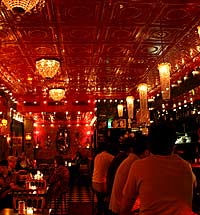
Simone Martini Bar has it all. Its merits are multifaceted, as witnessed by my visual aids: to the left, the outdoor kafana (multipurpose café, a watering hole for talking politics and gossip). To the right, the trendy NYC bar scene that brings out the fabulous glittering side in everyone (this one's for you, Cinnamon Jones!).

1) They consistently have best dirty martinis in Manhattan. Only word of caution: as in any bar, placing a martini order with a waiter rather than a bartender is always a risky business. For best results, go up and make a friend behind the bar.

2) They label themselves as a "martini and espresso bar", which means that the bar is good at any time of day, whether you want coffee, a drink, a meal, or all three!

3) A manageable noise level and unobtrusive music means that you will always be able to have a conversation as you sip that martini.

Atmosphere, better booze, camaraderie: the ABCs of the perfect bar.